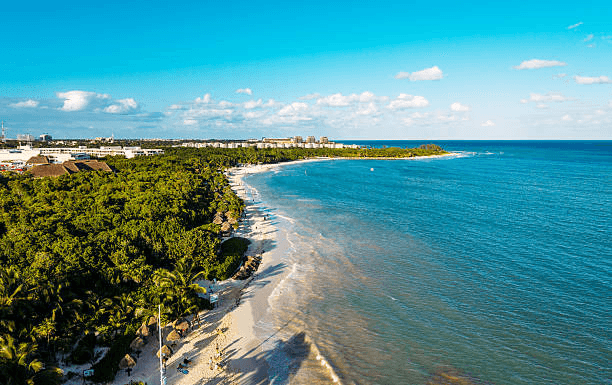
Riviera Maya · Quintana Roo
Coco Beach
PRIMEEstablished luxury residential zone with beachfront access. Dominant Canadian and American buyer profile. Mature market with strong liquidity and consistent appreciation.
Zone intelligence combines verified listing data, participant trust aggregates. Every metric below displays its confidence level. This is market intelligence, not financial advice — confirm figures independently before making investment decisions.
Coco Beach is a physically constrained, beachfront-prime zone in Playa del Carmen with a single tracked price point of $2,531 per m² and 14 active listings — a thin dataset that makes trend analysis premature and warrants a low confidence overall. The zone's structural story is coherent: no new permits, genuine beachfront scarcity, and a dominant North American buyer profile that has historically supported values here. What the data cannot yet answer is whether that story is still playing out at current prices, because participant coverage and STR performance verification for this zone are still building — and the Canadian buyer concentration flagged in the signals represents a real single-cohort demand risk that mature investors should underwrite explicitly rather than hand-wave away.
Market Snapshot
Estimated Buyer Composition
AI-synthesized estimate — not derived from transaction registry data
Macro Exposure Matrix
Latest Intelligence Signals
STR yield thesis not yet independently verified for this zone
No STR yield, nightly rate, or occupancy data is tracked for Coco Beach at this time, so the rental income dimension of any investment thesis rests on market-level assumptions rather than zone-specific performance data. That is a transparency gap worth naming clearly. Investors underwriting a yield-driven acquisition here should seek property-level STR history directly from sellers or operators until platform coverage catches up.
Zero permits reinforce structural beachfront scarcity
No permit activity is on record for Coco Beach, which is consistent with a mature, constrained beachfront zone where developable land is effectively exhausted. Scarcity of this kind is a durable pricing floor — you cannot manufacture more beachfront, and the regulatory environment along this corridor makes new beachfront entitlements increasingly difficult to obtain. For existing holders, this is structurally supportive.
Demand signals not yet independently tracked for this zone
Days-on-market, price-cut frequency, and listing velocity are not yet tracked for Coco Beach, which means the platform cannot currently characterize buyer urgency or absorption pace from its own data. The editorial profile describes strong liquidity and consistent appreciation for the zone — but those characteristics are not yet independently verifiable from platform metrics. Coverage is building; investors should supplement with local agent intelligence in the interim.
Canadian buyer concentration creates single-point demand fragility
When a prime beachfront zone's demand engine is heavily concentrated in a single foreign nationality, the market's resilience narrows to whatever is happening in that cohort's home economy. The signals flag this Canadian concentration twice, which is not an editorial accident — it reflects a real structural vulnerability. A sustained CAD/USD move, a Canadian housing correction that constrains liquidity, or any policy friction affecting cross-border property purchases would hit this zone's buyer pool with outsized force.
No participants tracked yet in this zone
The platform's participant coverage for Coco Beach is still in its early stages — no agencies, developers, or notarios are currently tracked, which means the trust layer for this zone cannot yet be independently verified. This is a coverage note, not a verdict on the market's professional ecosystem. Coco Beach is an established zone with active real estate activity; participant verification is simply a capability the platform has not yet deployed here.
Single price point makes trend analysis impossible today
With one month of tracked price history and a single observation at $2,531 per m², there is no basis for computing appreciation, identifying direction, or assessing momentum. A market that cannot yet show you where it has been cannot reliably tell you where it is going. Coverage is still building for this zone, and investors should treat the price reference as a starting point, not a trend.
Beachfront hurricane exposure is a permanent structural risk
Coco Beach's beachfront positioning is its core value driver and its most durable physical liability — these two facts are inseparable. Hurricane season runs June through November every year without exception, and beachfront assets in this corridor carry above-average insurance requirements, storm vulnerability, and potential STR revenue disruption during peak exposure months. Buyers who understand this reality price it in; buyers who don't are setting themselves up for an unpleasant education.
STR yield thesis carries zero independent verification
The investment case for beachfront units in any Riviera Maya zone rests heavily on short-term rental income, yet no STR yield data has been tracked for Coco Beach. Buyers relying on developer-provided yield projections have no independent baseline against which to validate those numbers. A thesis built on unverified assumptions is not an investment thesis — it is a hope.
Beachfront hurricane exposure is permanent structural risk
Coco Beach's direct coastal position is its primary asset and its most durable liability. Hurricane season runs June through November every year without exception, and beachfront properties absorb the full force of any significant storm. Insurance costs, post-event rental interruption, and structural repair cycles are real expenses that must be modeled into any return projection — and currently, there is no data in this system to help size them.
Zero permits confirm structural beachfront scarcity intact
No permit activity has been recorded in the supply pipeline for Coco Beach, which is consistent with the physical reality of a mature, land-constrained beachfront zone. New supply cannot be manufactured in this location, and the absence of permits suggests no developer is attempting to do so through densification or rezoning. Scarcity, at minimum, is not being actively eroded.
Zero tracked participants leave trust layer entirely absent
With zero agencies, developers, and notarios tracked in the participant ecosystem, the trust infrastructure that underpins responsible foreign investment in this zone is completely invisible to the platform. This is not a minor gap — it means there is no independently verified counterparty to any transaction a foreign buyer might contemplate here. Until participants are onboarded and scored, trust-dependent due diligence cannot be performed.
Ninety-day demand window is completely dark
There are no active listing counts, no days-on-market figures, no price-cut velocity, and no buyer activity signals in the dataset for the past ninety days. This does not mean demand is absent — it means the platform cannot see it. For an investor making a capital commitment, the difference between a dark data window and a quiet market is not academic; it is the entire basis of underwriting confidence.

The Riviera Maya, measured.